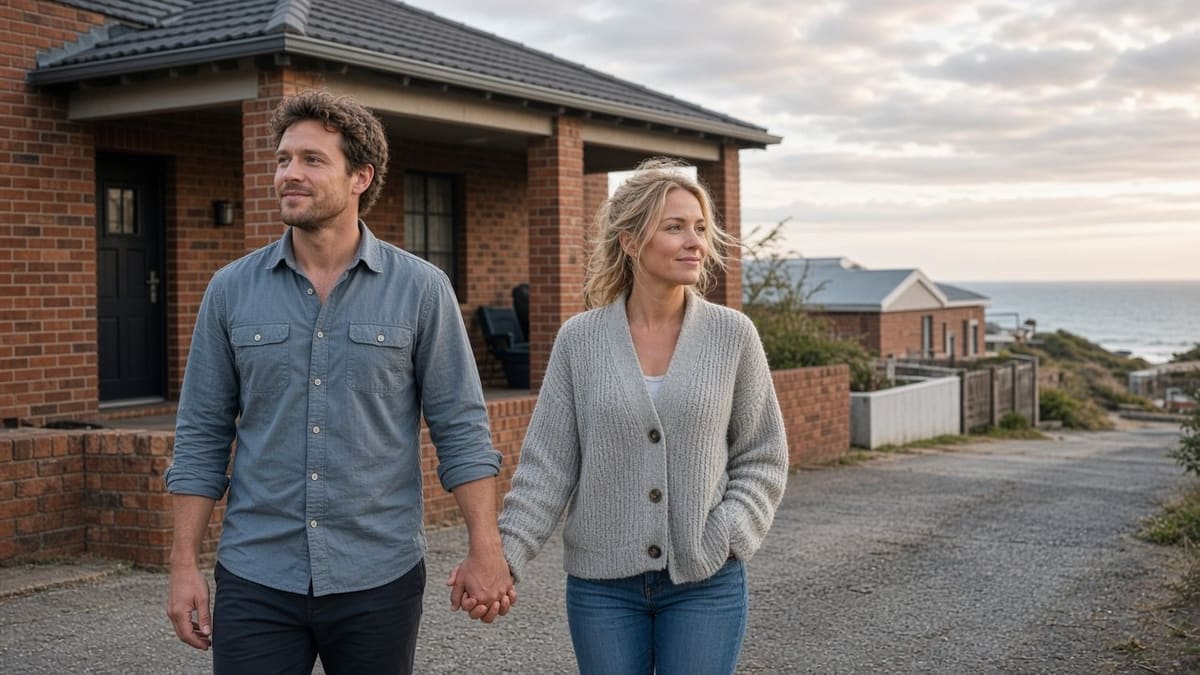
Three years of saving
Ryan and Carla Fourie rent a semi-detached house in Walmer, Gqeberha. Ryan is a crane operator at the port. Carla is a dental assistant. They are both 32, and for three years they have saved towards a home of their own.
By October they had R190 000 in a savings account. They found a three-bedroom house in Lorraine for R1 450 000. "The agent asked how much deposit we had," Carla says. "We said, how much do we need? Nobody gave us a straight answer."
Why a deposit matters
Some South African banks lend up to 100% of the purchase price to buyers who qualify. Others ask for a deposit, often 10% or more. The bank decides after it assesses your income, expenses, credit record and the property.
A deposit helps in three ways:
- It lowers the amount you borrow, so the monthly instalment is smaller.
- It lowers the total interest paid over the term of the bond.
- It can help your application, because the bank takes less risk.
It also has a cost. Money used as a deposit is no longer available for transfer costs, moving or emergencies.
"Every rand of deposit felt like a rand we could not touch. Then we saw what each rand saved over twenty years."
The once-off costs come first
Before choosing a deposit, the Fouries listed the costs they would need to pay in cash.
Transfer duty. For 2026/27, SARS charges no transfer duty on property up to R1 210 000. Between R1 210 001 and R1 663 800, the duty is 3% of the value above R1 210 000. On a price of R1 450 000, that is 3% of R240 000, or R7 200.
Attorney and Deeds Office costs. The transfer attorney and the bond attorney charge fees that rise with the price and the bond amount. These vary, so the Fouries asked their conveyancer for a written quote.
Moving and setting up. A truck, a few appliances and some repairs before they move in.
They set aside R55 000 for all once-off costs, based on the quote and a margin, and R30 000 as an emergency fund. That left R105 000 for a deposit, about 7% of the price.
Comparing deposits
To see what each option meant, they compared three deposits at an assumed rate of 11% over 20 years.
| Deposit | Bond amount | Monthly instalment | Total interest over 20 years |
|---|---|---|---|
| 0% (R0) | R1 450 000 | about R14 970 | about R2 142 000 |
| 10% (R145 000) | R1 305 000 | about R13 470 | about R1 928 000 |
| 20% (R290 000) | R1 160 000 | about R11 970 | about R1 714 000 |
Illustrative
A 10% deposit lowers the instalment by about R1 500 a month and saves about R214 000 of interest over the full term, compared with no deposit. A 20% deposit saves about R428 000. These figures assume the rate stays at 11% for twenty years, which it will not. They are a guide to scale, not a forecast.
The choice they faced
The Fouries could not reach 20% without emptying their emergency fund. They looked at three paths:
- Buy now with R105 000 down. Keep their R30 000 emergency fund and the R55 000 for costs.
- Wait a year and save another R60 000, while paying R11 500 a month in rent.
- Buy now with R145 000 down, using part of the emergency fund, and rebuild it over the next year.
Waiting a year would cost them R138 000 in rent, and the house price might change. Using the emergency fund felt risky, with Ryan's shift allowances varying month to month.
Extra payments as a second deposit
A bond allows extra payments at any time. Each extra rand reduces the capital and the interest that follows. The Fouries realised that a smaller deposit now did not lock them in. They could pay an extra R1 000 a month once the emergency fund was rebuilt, and shorten the bond by years.
They also checked that their bond would let them draw back extra payments in an emergency. Many bonds offer an access facility, and the terms differ between banks.
How they decided
Ryan entered the price, three deposit options and two interest rates in the Buying a Home view on MeerkatGenie. It showed the instalment and the total cost beside their monthly cash flow and their rent today. At a 13% rate, the 7% deposit option still left them R4 000 a month spare.
They chose path one. The bank approved a bond of R1 345 000. Transfer took ten weeks.
Questions before you choose a deposit
- How much cash will transfer duty, attorney fees and moving take?
- Will you still have an emergency fund after transfer?
- How much does each extra R50 000 of deposit lower the instalment?
- Does your bond allow extra payments and access to them later?
- What would waiting a year cost in rent?
Your takeaways
- A deposit lowers your bond, your instalment and your total interest.
- Set aside cash for transfer duty, attorney fees and moving before choosing a deposit.
- For 2026/27, transfer duty is 0% up to R1 210 000 and 3% on the part above that, up to R1 663 800.
- Keep an emergency fund even if it means a smaller deposit.
- Extra bond payments later can work like a second deposit.
- Compare the cost of waiting, including rent, with the cost of a smaller deposit.
Editor's note: This is an illustrative composite story. The people in it are not real, and their words are not interviews or testimonials. All figures are an Illustrative sample.
Related articles
- What bond can you carry? A Centurion constable tested her first-home budget before the bank did
- Rent or buy? Two Bloemfontein sisters took opposite paths and compared them over ten years
- How big should your emergency fund be? What one Kimberley family learned the week the geyser burst
MeerkatGenie does not give financial advice and promises no outcome. For advice, speak to an independent professional listed in the MeerkatGenie directory.
See what this could mean for your month
Build a free financial model on MeerkatGenie to test this life event with your own figures, or find an independent professional to talk it through.
Illustrative and educational only. Not a quote, not a contract, and not FAIS advice. Updated 27 November 2026.