The road north
Every day, the N1 carries a river of trade through Polokwane. Trucks heading for Beitbridge and Zimbabwe. Buses to Musina and Thohoyandou. Bakkies loaded with cement for a new house in Seshego, seed for a farm near Tzaneen, or tiles for a renovation in Bendor.
Polokwane is the capital of Limpopo and the commercial heart of the province. Government, retail, agriculture and mining services keep its economy moving. And because so much of Limpopo buys here, a small business in the city often serves customers a hundred kilometres away.
That makes Polokwane a city of founders, and of bakkies.
Tshepo's hardware store
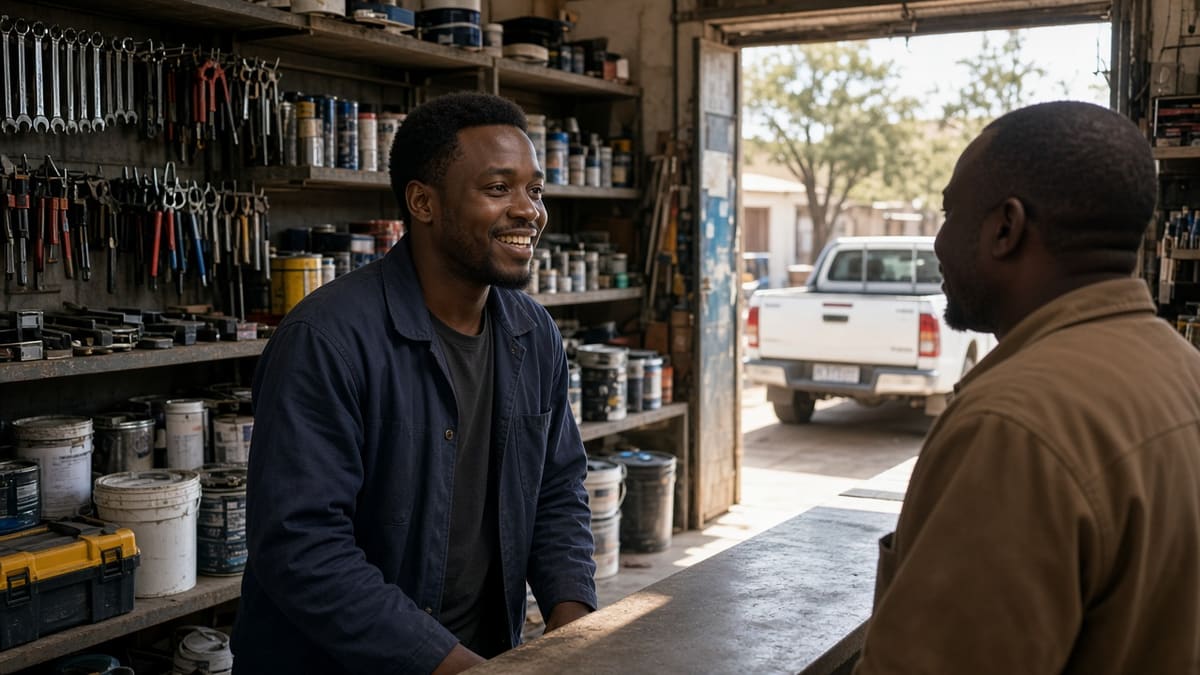
Tshepo Mabunda opened his hardware store near the city centre three years ago, at twenty-six. Builders from Seshego and Mankweng buy cement and paint, some on account. His bakkie makes two delivery runs a day. Every month, he sends money home to his mother in Ga-Mphahlele.
"In my first year, I thought I was doing well," he says. "The shop was full. The till was full. And then I could not pay my supplier."
Editor's note: This is an illustrative composite story. The people in it are not real, and their words are not interviews or testimonials. All figures are an Illustrative sample.
The cash gap that nearly closed him
Tshepo's supplier wanted payment before goods left the warehouse. His builders asked for thirty days. He had made the sales, but the cash was not in the bank.
At one point, almost R80 000 was owed to him by customers. He was borrowing from family to restock.
Now he checks unpaid accounts every Friday. New customers pay cash for their first three orders. Regulars get credit with a written limit. When a big customer insists on sixty days, the cost of waiting goes into his quote. "I am not a bank," he tells them, kindly but firmly.
Paying himself a salary
For two years, Tshepo treated the till like a family bank account. School shoes for his sister. A funeral contribution. Petrol. It all came from the business.
Illustrative sample: Today, the business pays Tshepo R15 000 a month on the last Friday. From that salary, he sends R3 000 to his mother. The business keeps the rest for stock and growth.
In the Starting a Business view in MeerkatGenie, he keeps a business budget separate from his family budget. He tests what happens if a big builder pays sixty days late, or if sales dip in January, before it happens.
"The shop pays me a salary. The family gets what the salary allows. Mixing the two nearly closed my doors."
The bakkie question
A delivery bakkie earns its keep only if each trip makes money after fuel, servicing, insurance and time. Tshepo now batches deliveries by area and charges a delivery fee beyond twenty kilometres. "An empty bakkie coming back from Mankweng is just a very expensive drive," he says.
When VAT arrives
Growth brings tax questions. From 1 April 2026, VAT registration is compulsory once taxable supplies pass R2.3 million in any consecutive twelve-month period. The application is due within 21 business days of crossing that line. Voluntary registration is possible above R120 000. Once registered, the VAT he collects belongs to SARS, not to his working capital. Tshepo's accountant tracks his rolling turnover each quarter.
What Polokwane founders know
Tshepo is one of many young business owners in the city who serve a province, not just a suburb. They learn fast that busy is not the same as profitable, and that cash, not sales, keeps the doors open. On the Genie Desk, the "Starting a venture in Polokwane" preset lets you test a slow quarter before it arrives.
MeerkatGenie lists independent accountants and tax practitioners in Limpopo. Read How much money does it take to go out on your own? A Pretoria plumber added it up before he left.
MeerkatGenie does not give financial advice and promises no outcome. For advice, speak to an independent professional listed in the MeerkatGenie directory.
Related articles
- How much money does it take to go out on your own? A Pretoria plumber added it up before he left
- What does it really cost to open a small business in South Africa? One Umlazi salon owner counts every rand
- Leaving a salary for a food truck: the six questions a Mbombela chef answered before she resigned